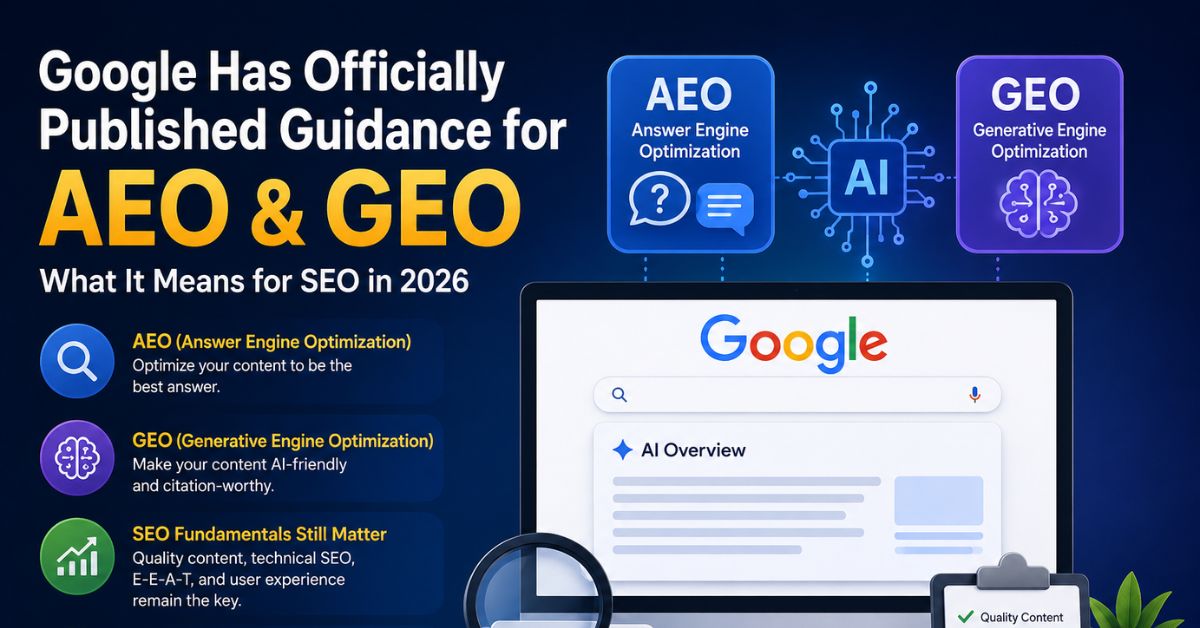
The world of digital marketing is changing rapidly with the rise of Artificial Intelligence in search engines. Over the last few years, terms like AEO (Answer Engine Optimization) and GEO (Generative Engine Optimization) have become increasingly popular among marketers, SEO professionals, businesses, and content creators. Many people believed that AI-powered search would completely replace traditional SEO strategies.
However, Google has now officially clarified its stance on AEO and GEO, and the announcement has created a major discussion in the SEO industry.
According to Google’s latest guidance, AEO and GEO are not entirely separate from SEO. Instead, Google explained that the same SEO fundamentals still play the biggest role in ranking content for AI-powered search experiences such as AI Overviews and AI Mode.
This update is extremely important for businesses, marketers, students, and digital marketing professionals because it changes how we should approach content creation and search optimization in 2026.
In this blog, we will understand:
-
What AEO and GEO mean
-
Why these concepts became popular
-
What Google officially said
-
How AI search works
-
What businesses should focus on now
-
The future of SEO in the AI era
What is AEO (Answer Engine Optimization)?
AEO stands for Answer Engine Optimization.
It refers to optimizing content so that AI-powered search engines and assistants can directly use your content to answer users’ questions.
For example:
-
Google AI Overviews
-
ChatGPT
-
Gemini
-
Perplexity AI
-
Voice assistants like Alexa and Siri
These platforms try to provide direct answers instead of simply showing a list of websites.
AEO focuses on:
-
Clear answers
-
Question-based content
-
Structured formatting
-
FAQs
-
Featured snippets
-
Semantic relevance
The goal is to make your content easy for AI systems to understand and present as an answer.
What is GEO (Generative Engine Optimization)?
GEO stands for Generative Engine Optimization.
This concept focuses on optimizing content for AI-generated search experiences where AI tools summarize information from multiple sources and generate a custom response for users.
Unlike traditional search engines, generative AI does not always show 10 blue links. Instead, it creates conversational answers using information from websites across the internet.
GEO strategies often include:
-
Building brand authority
-
Increasing online mentions
-
Publishing expert content
-
Using structured data
-
Creating topical authority
-
Improving citation potential
The objective is to increase the chances of your content or brand being referenced by AI systems.
Why Did AEO and GEO Become Popular?
The popularity of AEO and GEO increased after the launch of:
-
Google AI Overviews
-
OpenAI ChatGPT
-
Microsoft Copilot
-
Perplexity AI
-
Gemini AI
These tools changed user behavior significantly.
Instead of searching:
“Best digital marketing course in Gurgaon”
Users now ask:
“Which is the best institute for digital marketing in Gurgaon with placement support?”
AI tools provide direct conversational responses, reducing the need for users to click multiple websites.
This led many marketers to believe:
“Traditional SEO is dead.”
As a result, several new AI optimization strategies started trending online.
What Google Officially Said About AEO & GEO
Google recently released official guidance clarifying how AI search works.
The company clearly stated that:
“AEO and GEO are still fundamentally SEO.”
This means:
-
Traditional SEO principles still matter
-
AI search relies heavily on Google’s existing ranking systems
-
Websites still need quality SEO to appear in AI-generated results
Google emphasized that there is no completely separate AI ranking algorithm specifically for AI Overviews.
This is a major clarification because many marketers were promoting complicated AI-specific tactics that may not actually help rankings.
Google’s Main Recommendations for AI Search Optimization
According to Google, businesses should continue focusing on strong SEO fundamentals.
1. Create Helpful Content
Content should genuinely solve users’ problems and answer real questions.
Google prioritizes:
-
Useful information
-
Clear explanations
-
Experience-based insights
-
Original content
Thin or AI-spammed content is unlikely to perform well.
2. Focus on E-E-A-T
Google continues emphasizing:
-
Experience
-
Expertise
-
Authoritativeness
-
Trustworthiness
AI systems prefer reliable sources.
To improve E-E-A-T:
-
Show author credibility
-
Add real-world examples
-
Include case studies
-
Use trustworthy references
-
Maintain transparency
3. Improve Technical SEO
Technical SEO remains critical.
Google recommends:
-
Fast website speed
-
Mobile-friendly design
-
Crawlable pages
-
Proper indexing
-
Clean site structure
-
Secure HTTPS websites
AI systems still depend on accessible and well-structured content.
4. Match Search Intent
Understanding user intent is more important than ever.
Your content should answer:
-
What users want
-
Why they are searching
-
What problem they are trying to solve
For example:
Someone searching “best SEO course” may want:
-
Reviews
-
Fees
-
Placement support
-
Course syllabus
-
Career opportunities
Content should address all these aspects comprehensively.
5. Use Structured Formatting
AI systems prefer content that is easy to understand.
Use:
-
Headings
-
Subheadings
-
Bullet points
-
FAQs
-
Tables
-
Simple language
Well-structured content increases readability for both users and AI systems.
What Google Says You DON’T Need
One of the most surprising parts of Google’s guidance was what they said is unnecessary.
Google suggested that websites do NOT need:
-
Special AI schema
-
llms.txt files
-
Artificial AI-focused formatting
-
Keyword stuffing for AI
-
Manipulative citation tactics
This means businesses should avoid chasing unnecessary trends and instead focus on quality SEO practices.
Is Traditional SEO Still Important in 2026?
Absolutely yes.
SEO is not dead. In fact, it is evolving.
AI-powered search still depends heavily on:
-
Content quality
-
Website authority
-
User experience
-
Technical optimization
-
Brand trust
The difference is that AI search now rewards:
-
Contextual understanding
-
Natural language
-
Topical authority
-
Comprehensive answers
Modern SEO is becoming smarter rather than disappearing.
How Businesses Should Adapt in the AI Era
Businesses should now combine traditional SEO with AI-focused content strategies.
Best Practices for 2026
Publish High-Quality Educational Content
Create blogs, guides, tutorials, and case studies that provide genuine value.
Build Brand Authority
Brands with stronger online presence are more likely to be referenced by AI systems.
Optimize for Questions
Use conversational keywords and FAQ sections.
Improve User Experience
A fast and easy-to-use website improves rankings and engagement.
Focus on Topic Clusters
Cover topics deeply instead of publishing random isolated articles.
Earn Mentions & Backlinks
AI systems often recognize authoritative brands that are widely discussed online.
What About ChatGPT, Perplexity, and Other AI Platforms?
Google’s guidance mainly applies to Google Search and AI Overviews.
However, other AI platforms may work differently.
Tools like:
-
ChatGPT
-
Claude
-
Perplexity AI
-
Gemini
may consider additional signals such as:
-
Brand mentions
-
Community discussions
-
Reddit conversations
-
Expert citations
-
Public trust signals
This is why businesses should focus on overall digital authority, not just rankings.
The Future of SEO, AEO & GEO
The future of search is clearly AI-driven.
But the core principle remains the same:
Helpful content wins.
Whether users discover content through:
-
Traditional search results
-
AI Overviews
-
Voice search
-
ChatGPT recommendations
-
AI assistants
the websites that provide real value will continue succeeding.
The future belongs to brands that:
-
Build trust
-
Create quality content
-
Understand user intent
-
Maintain strong technical SEO
-
Adapt to changing search behavior
Final Thoughts
Google’s official guidance on AEO and GEO has finally brought clarity to the digital marketing industry.
The biggest lesson is simple:
You do not need to abandon SEO for AI search.
Instead, businesses should evolve their SEO strategies to align with how modern AI-powered search engines understand and present information.
AEO and GEO are not replacements for SEO. They are extensions of good SEO practices in the age of Artificial Intelligence.
If your website focuses on:
-
Helpful content
-
Strong SEO fundamentals
-
User experience
-
Brand authority
-
Trustworthiness
then you are already preparing your business for the future of AI-driven search.
As search technology continues evolving in 2026 and beyond, one thing remains constant: